What happens to books described as MINOR CLASSICS? I once asked a small-press publisher. They go out of print, he told me.
I thought of that remark this morning when I was looking again at a new book of poetry called The Last Bright Apple by the poet and publisher Peter Jay, a man best known for much of his working life as the founder and publisher of Anvil Press.
Anvil not only published a remarkable roster of poets, but also did so with some style. Peter Jay cared about how the books looked and felt in the hand.The paper on which the books were printed did not discolour after eighteen months.
I was first asked to review a book published by Anvil in 1984, when I was reviewing books of poetry for a monthly magazine called Books & Bookmen. The book was called Les Chimeres and its author was a 19th-century French art critic and poet called Gerard de Nerval. And its translator? Peter Jay, who was also its publisher.
Several things struck me about this book: that it had been published at all; that it was in hardback, which gave it a sense of authority that it deserved; and that it was such a beautiful object, so lovingly crafted.
I also thought this: only a dedicated madman would publish such a book as this in these inclement times. How many people will buy a book of poetry in translation?
But this gets us down to the nub of it. Publishers of poetry, those who establish and run small presses, generally are madmen. And mad women too. They have nothing to gain except to be known by a grateful few as publishers of poets who would often otherwise remain almost entirely unknown. Peter was one of those.
What is less known is the fact that Peter Jay was a fine poet in his own right, and this new book shows off his talents as a poet as never before, and a part of that talent was an ability to take off from, or perhaps to riff on, poets of the past, and they were usually much more temporally remote poets than Gerard de Nerval.
The book is slender. You can read it at a single evening sitting, as I did. It is a book of tender reserve, of wistfulness, of the reaching out for symphonic moments which, grasped after, often seem to recede into a mist of incomprehension or unknowing. It is also, needless to say, a book deeply informed by the history of poetry and its past.
Peter rather regrets the fact that there is not more of it, that he did not squeeze more of the poet out of himself.
That, of course, is one of the curses of being a small-press publisher, that a strange, selfless dedication to publishing the poetry of others comes first.
The Last Bright Apple is published by Grey Suit Editions at £15 – Review by Michael Glover.
And there is now another review by Matthew Paul – scroll down to the end of the post to find it!
This new publication from Grey Suit Editions UK is now available in bookshops and from Ingram Publisher Services UK.
There is also a free Heyzine book brought out to accompany this printed publication. It is my collected ABSTRACTIONS
I have brought this out because I felt that my abstract writings including the long poem Love and Tears and the sequence Modern Sonnets were better kept together.
And here is a review by Jennifer Johnson that has come out in LONDON GRIP.
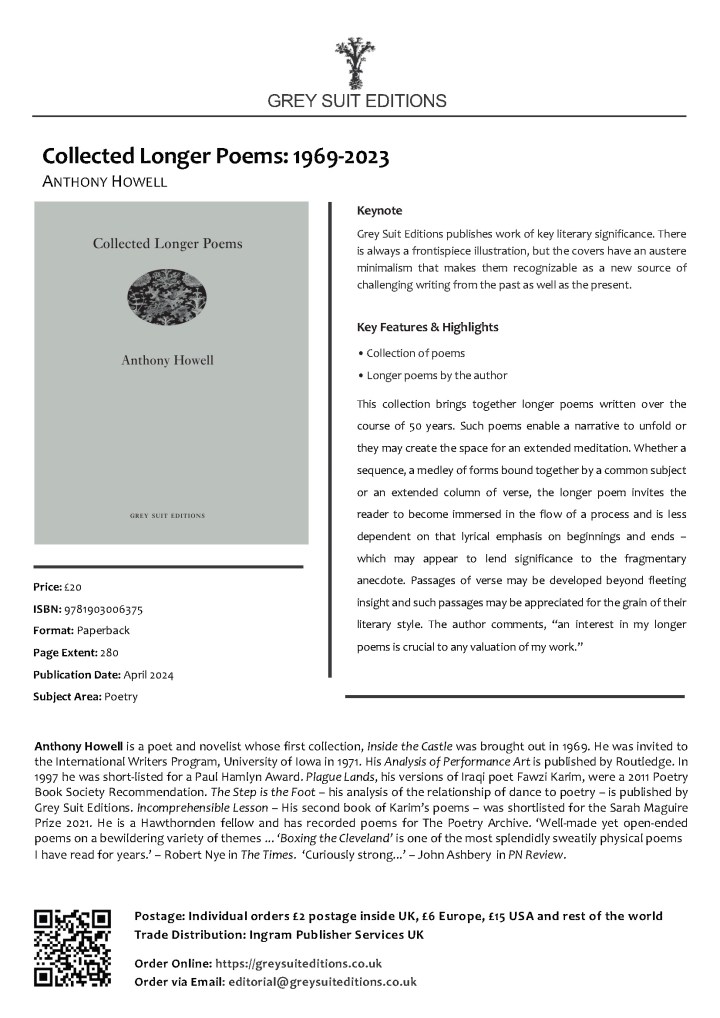
Collected Longer Poems
Anthony Howell
Grey Suit Editions
Paperback ISBN 978-1-903006-37-5
e-Book ISBN 978-1-903006-37-5
280pp	£20.00
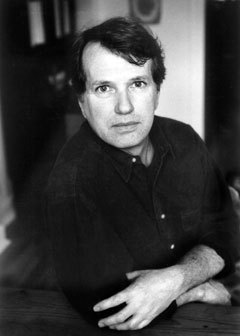
Anthony Howell, 80, has a Wikipedia page showing his many achievements. He worked for the Royal Ballet before concentrating on writing poems, novels, plays and translations. He is also a visual artist, publisher and has run poetry events at The Room.
Howell’s Collected Longer Poems consists of 22 poems of varying lengths and styles written over 50 years; and they come with praises by Donald Gardner, Sylvia Kantaris, Robert Nye and John Ashberry. Regarding longer poems, Howell says, “the longer poem invites the reader to become immersed in the flow of a process and as such it is less dependent on that lyrical emphasis on beginnings and ends – which may seem to lend significance to a fragment or an anecdote”. While I cannot do justice to this major collection in a short review I will make a few observations. Hopefully, the illustrative lines I quote will show the range of Howell’s writing.
Several of Howell’s poems tend toward a maximalist style with much detail. According to Auerbach in his book Mimesis, this foregrounding of detail is more characteristic of classical writing than that of the biblical tradition. Following the former tradition is perhaps unsurprising for someone who has received critical acclaim for his versions of poems by the Latin poet Statius. Statius appears in ‘Dancers in Daylight’, “looking up in awe/At rafters there no longer.” Howell has also been influenced by the abstract poet John Ashberry whose poetry puts the emphasis on language rather than meaning. We are told that “Ashberry approves of the results” of Howell’s version of Fawzi Karim’s ‘Empyrean Suite – Poems from the Afterlife’. Howell describes his own technique as “description without motive” with the emphasis on detailed description rather than narrative meaning.
Let us look at the beginning of ‘Boxing the Cleveland’.
A coach-built lorry, several metres long,
Is backing down the grass-bound lane between
The weather-boarded shack where clothes are hung
And that old shed for wood. The lane leads on

Past chicken runs behind a criss-cross fence
On the woodshed side, beyond the much-decayed
Remains of a kennel, overgrown with dense
Nettles and docks, and then on past those frayed

Rails the horses gnaw through the winter, bordering
The sunset paddock, there on the laundry side.
Notice also how each line begins with an initial capital. Howell’s reason for doing this can be found in an article he wrote for The High Window.
One of the poets Ashberry admired was F.T. Prince and, in the poem ‘The Ballad of the Sands’, Howell follows a verse form pioneered by F.T. Prince which uses a six-line stanza with two rhymes and two unrhymed lines. As Howell says, “the form mediates admirably between stricture and freedom.” The following stanza shows Howell’s skill in formal writing.
Her footprints are soon
Smoothed over by the wind
And you lose their descent
In some crater of the dune
Where the shades crescent
Enlarges afternoon.
Some of Howell’s poems are meditations such as the ‘Songs of Realisation’. Here is an extract.
But what fills space, if anything? Emptiness I disown.
I sit beneath the fig, look upwards at the sun,
Gazing through a leaf as I turn brown.
From some other view, the leaf is simply green;
From underneath, a filigree of tributaries, a delta flooding
Backwards on itself, feeding on light while drinking moisture.
The disowning of emptiness shows Howell’s original mind. But seeing things from different perspectives – which Howell often does – can have a certain danger. In ‘Heron of Hawthornden’ he writes wittily
It’s my fault. Haven’t the sense to keep
My mouth shut. Cultural ladies and gents
Like nothing better than to bathe together in agreement’s
Glow.
More wit can be found in his versions of Fawzi Karim’s ‘Empyrean Suite: Poems from the Afterlife’
Basil sat by my grave today,
           reading me my poems.
I must say it was difficult to hear,
Being far above, rather than below and near.
He then began to write himself.
While the title of Howell’s poem ‘My Part in the Downfall of Everything: A Satire on Deceit’ is witty the subject of the satire is grim as the following stanzas show.
My Jewish ‘Opa’ cooled his hands
In an anteroom as General Goering addressed
The rest of a Zionist delegation.
Brandishing a wad of clippings, Goering
Launched into a harsh denunciation

Of those among the populace responsible
For spreading anti-Nazi propaganda
In Britain and America – gross exaggerations,
Detailing atrocities that constituted
Fabrications. ‘Put a stop to these

Libellously false reports immediately
Or I shall not be able (or inclined)
To guarantee the safety of the Jews.’
Opa means grandfather. Howell’s interest in the bleak may be suggested by the last line of ‘The Photographer’, ‘Then for something utterly ugly makes for the perfect shot’. The following lines in ‘A walker on the wall’ give a visual description of everyday ugliness.
Broken, where the wall surveys the sea,
And left as flotsam shored against its mound,
Lie jerry-cans, the torn hoods off prams
And ruptured tires distorted by their scorching:
The poem ‘Silent Highway’ about the history and mythology of the Thames begins with a description of what would normally be seen as ugly in a celebratory tone.
1. Heraclitus

Apotheosis! Arsenals of the sky
Ablaze, exploding, crimsoning the crowns
Of storm clouds over Woolwich with its furnaces
Producing the great barrels of our guns.
Throughout the book are many references to poets of the past and adaptations of famous lines. One example also comes from ‘Silent Highway’, this time in the ‘Windrush’ section.
Sweet Thames, run softly, till me end I song,
Me quit the West Indies and the journey be long.
This adaptation of a line by Spenser and borrowed by Eliot introduces the speech of newcomers.
I would highly recommend Collected Longer Poems because Howell, through his skilful and wide-ranging writing, shares with the reader his considerable knowledge and original way of seeing the world.
The Austrian literary magazine has just published two stories by David Plante – translated by Gwendolyn Leick before she passed away. Both stories were first published by Grey Suit Editions.
Grey Suit also published two books by Gwendolyn Leick – Gertrude Mabel May and Franckstrasse 31
One story from David Plante’s Essential Stories– published by Grey Suit Editions 2022
THE CANOE
They were talking about a pine tree in the woods that was struck by lightning.
Father and son were on the screened-in porch, the screens seething with a warm breeze from the lake, then his son, saying nothing, went out through the screen door, and his father accepted that his son could walk off, after a silence between the two, to go he had no idea where.
Then he went out and down the rough path to where there was a narrow beach, and he sat on a bench made of a thick plank supported on rocks. The breeze caused low, long waves on the lake,
Once, his son had expressed the loose idea of becoming a priest, and this his father thought was one with his many loose ideas, but, again, no mention was made of the idea.
As the sun set a stillness spread over the lake, and a faint mist rose from the stillness, and fish broke the stillness in widening circles, the widening circles, he thought, of immortality.
He saw a canoe out on the lake, gliding towards the far shore. He was sure his son was in the canoe, which, from time to time, he let drift.
He stood, his behind aching from sitting on the bench. He was a man with short, bristling, grey hair, and in the shadows his face appeared gaunt. He slowly climbed the path from the lake to the house, and as he passed the woods that began where the path ended, he stood back when he saw his neighbour, a girl, standing among the trees.
She was wearing a loose white shift and she was barefoot, and her slender arms and legs were bare. She had walked through the woods on a path to come, she said, to visit, and she was just about to return to her parents’ house when she saw him. She followed him to the door of the porch, but stood outside when he went in and switched on a light. He held the door open for her, but she didn’t enter.
Did you see the pine tree that was struck by lightning? she asked.
No, but I think I saw the flash.
I saw it too.
She was a simple girl, perhaps simple-minded, whose parents were among the few old generations who lived around the lake, parents who might have been considered poor trash, if they were considered at all by the people from the city who had built houses on the lake.
The lightening cracked the trunk of the tree right down the middle, she said. It was that strong.
I guess it had to be that strong to crack the tree right down the middle-
Hesitantly, the girl asked, is he around?
He’s out in his canoe.
I was just wondering.
She was, she knew, soft on his son, in her simple way.
He said, why don’t you come in and wait for him? I’m sure he’d like to see you.
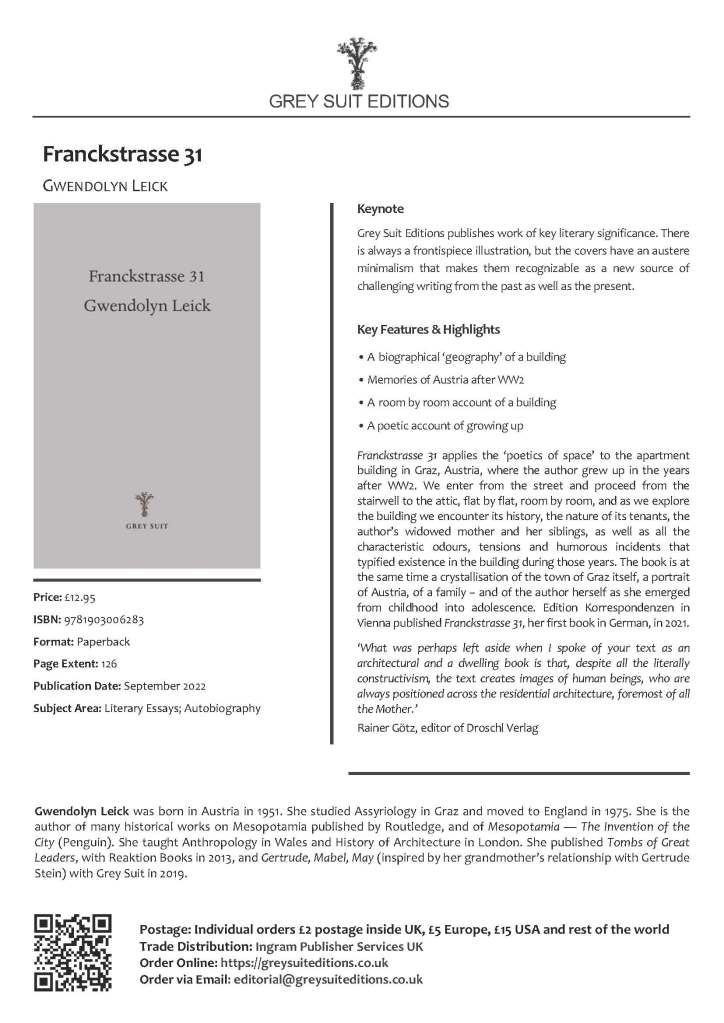
My brilliant friend Gwendolyn E Leick‘s two recent memoirs, both written in German and originally published in Austria, have been lauded in Europe and are being showcased right now at the Frankfurt Bookfair. I highly recommend the English translation of the first book, FRANCKSTRASSE 31, available from Grey Suit Editions. It’s a coming-of-age memoir unfolded as a tour through the Graz apartment building Gwendolyn and her family lived in after her father died, tragically young. It’s a powerful narrative conceit: her close focus on architectural space results in a lucid analysis of class and family dynamics and a profound meditation on time. If you are interested in experimental narrative techniques, life writing, architectural historiography, and/or mother-daughter relationships, this book is for you!
Grey Suit Editions, run by Anthony Howell, also published Gwendolyn Leick’s momumental ‘encyclopedic enterprise’ GERTRUDE MABEL MAY: An ABC of Gertrude Stein’s Love Triangle (2019), which is a gloriously meandering exploration of Stein’s relationship with May Bookstaver, herself the lover of Mabel Haynes, Gwendolyn’s grandmother. With entries ranging from ‘Alcohol’ and ‘Analysis’ to ‘Wars’ and ‘Wives’ it runs a fascinating gamut, not just for Steinians!
All of this compelling creative non-fiction is even more remarkable given that Gwendolyn was previously known as a foremost Assyriologist, author of academic texts on ancient Mesopotamia. They too are invitingly written, with a strong interest in daily life, poetry and women’s experience and representation. What an ouevre! I just hope her second memoir, only just published in Austria, will soon be available in English as well. (Naomi Foyle)
Postage: Individual orders £2 postage inside UK, £5 Europe, £15 USA and rest of the world
Trade Distribution: Ingram Publisher Services UK
(But please note, Ingram orders only apply after publication in Oct/Nov – pre-publication orders and requests for review copies can be taken at the email below)
David Plante (born March 4, 1940 in Providence, Rhode Island) is an American novelist, diarist, and memoirist of both French-Canadian and North American Indian descent. He graduated from Boston College and the Université Catholique de Louvain. He taught creative writing at Columbia University. Plante lived in London, and now resides in Lucca, Italy. His novels examine the spiritual in a variety of contexts, and his work, for which he has been nominated for the National Book Award, includes The Ghost of Henry James (1970), Slides (1971) and Difficult Women (1983), a memoir of his relationships with Jean Rhys, Sonia Orwell, and Germaine Greer and also the widely praised Francoeur Trilogy–The Family (1978), The Country (1980) and The Woods (1982). His most recent book The Pure Lover (2009) is a memoir of Nikos Stangos, his partner of forty years. He has been published extensively including in The New Yorker and The Paris Review and various literary magazines.
David Plante by Peter Cameron
Here are some reflections.
I have found your ‘minimalist’ stories very interesting. I like the tension in them. They begin in medias res with an apparently ordinary situation and then almost immediately a subtle tension and a feeling of unspecified threat appear and gradually increase. At the end, the threat either suddenly reveals itself through a deadly outcome, or is partially and unexpectedly reversed (like in the “Mother” story where it is revealed that in reality the world does not matter, only the love between mother and child matters), or remains unresolved leaving the reader in a limbo of anxiety. These are bites of intense life.
I also find the reflexion on the process of writing very interesting, we readers are positioned by the author as witnesses in the writing process and, at the same time, become aware of the indeterminacy governing our lives.
Allow me to say that, as some of the stories in the collection reveal (i.e. ‘The Fall’, but not only that) your novel inspired by Francesca Caminoli’s story would work very well like this, beginning in medias res, gradually revealing the tension and the threat, focusing on the relationship between mother and child, and only very vaguely hinting at the context and characters bio. Also the intertextual reflexion on writing hinting at the possibility of rewriting the story and/or, perhaps, more likely, the lack of control on the part of the author on ‘that’ story, would be rather interesting.
Chiara Calabrese
For more about the author, who also writes poetry, click here.
ISBN 978-1-903006-27-6 – This title will be published Oct/Nov 2022
Postage: Individual orders £2 postage inside UK, £5 Europe, £15 USA and rest of the world
Trade Distribution: Ingram Publisher Services UK
(But please note, Ingram orders only apply after publication in Oct/Nov – pre-publication orders and requests for review copies can be taken at the email below)












 Grey Suit Editions UK