

Marian presenting our new book to the Bodleian
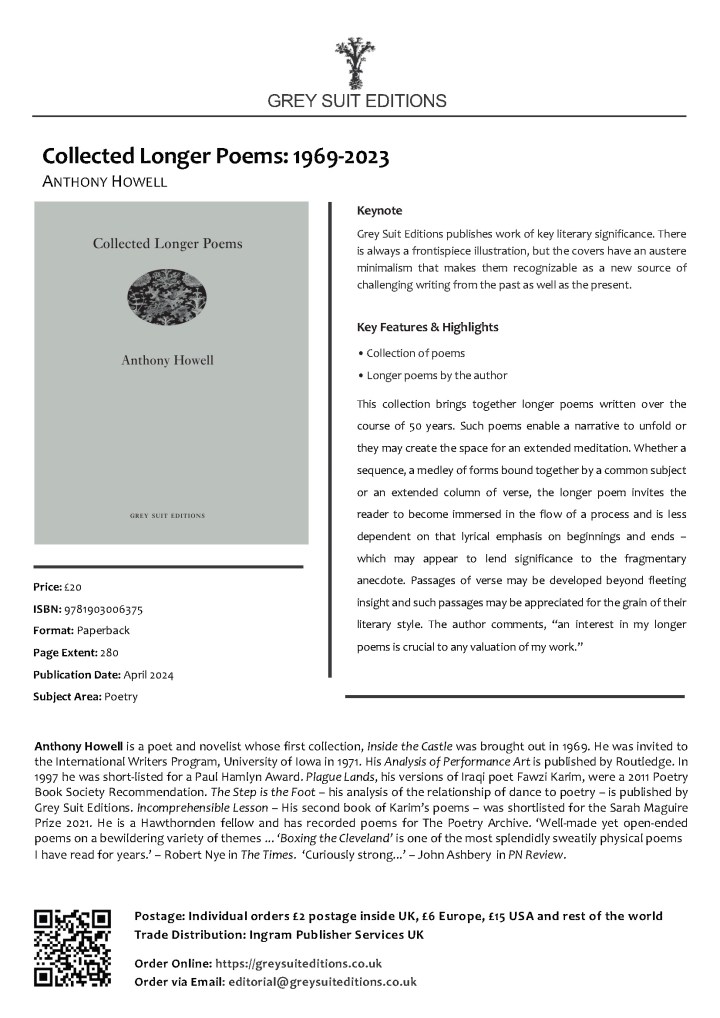
This new publication from Grey Suit Editions UK is now available in bookshops and from Ingram Publisher Services UK.


There is also a free Heyzine book brought out to accompany this printed publication. It is my collected ABSTRACTIONS
I have brought this out because I felt that my abstract writings including the long poem Love and Tears and the sequence Modern Sonnets were better kept together.
And here is a review by Jennifer Johnson that has come out in LONDON GRIP.
Collected Longer Poems
Anthony Howell
Grey Suit Editions
Paperback ISBN 978-1-903006-37-5
e-Book ISBN 978-1-903006-37-5
280pp	£20.00
Anthony Howell, 80, has a Wikipedia page showing his many achievements. He worked for the Royal Ballet before concentrating on writing poems, novels, plays and translations. He is also a visual artist, publisher and has run poetry events at The Room.
Howell’s Collected Longer Poems consists of 22 poems of varying lengths and styles written over 50 years; and they come with praises by Donald Gardner, Sylvia Kantaris, Robert Nye and John Ashberry. Regarding longer poems, Howell says, “the longer poem invites the reader to become immersed in the flow of a process and as such it is less dependent on that lyrical emphasis on beginnings and ends – which may seem to lend significance to a fragment or an anecdote”. While I cannot do justice to this major collection in a short review I will make a few observations. Hopefully, the illustrative lines I quote will show the range of Howell’s writing.
Several of Howell’s poems tend toward a maximalist style with much detail. According to Auerbach in his book Mimesis, this foregrounding of detail is more characteristic of classical writing than that of the biblical tradition. Following the former tradition is perhaps unsurprising for someone who has received critical acclaim for his versions of poems by the Latin poet Statius. Statius appears in ‘Dancers in Daylight’, “looking up in awe/At rafters there no longer.” Howell has also been influenced by the abstract poet John Ashberry whose poetry puts the emphasis on language rather than meaning. We are told that “Ashberry approves of the results” of Howell’s version of Fawzi Karim’s ‘Empyrean Suite – Poems from the Afterlife’. Howell describes his own technique as “description without motive” with the emphasis on detailed description rather than narrative meaning.
Let us look at the beginning of ‘Boxing the Cleveland’.
A coach-built lorry, several metres long,
Is backing down the grass-bound lane between
The weather-boarded shack where clothes are hung
And that old shed for wood. The lane leads on

Past chicken runs behind a criss-cross fence
On the woodshed side, beyond the much-decayed
Remains of a kennel, overgrown with dense
Nettles and docks, and then on past those frayed

Rails the horses gnaw through the winter, bordering
The sunset paddock, there on the laundry side.
Notice also how each line begins with an initial capital. Howell’s reason for doing this can be found in an article he wrote for The High Window.
One of the poets Ashberry admired was F.T. Prince and, in the poem ‘The Ballad of the Sands’, Howell follows a verse form pioneered by F.T. Prince which uses a six-line stanza with two rhymes and two unrhymed lines. As Howell says, “the form mediates admirably between stricture and freedom.” The following stanza shows Howell’s skill in formal writing.
Her footprints are soon
Smoothed over by the wind
And you lose their descent
In some crater of the dune
Where the shades crescent
Enlarges afternoon.
Some of Howell’s poems are meditations such as the ‘Songs of Realisation’. Here is an extract.
But what fills space, if anything? Emptiness I disown.
I sit beneath the fig, look upwards at the sun,
Gazing through a leaf as I turn brown.
From some other view, the leaf is simply green;
From underneath, a filigree of tributaries, a delta flooding
Backwards on itself, feeding on light while drinking moisture.
The disowning of emptiness shows Howell’s original mind. But seeing things from different perspectives – which Howell often does – can have a certain danger. In ‘Heron of Hawthornden’ he writes wittily
It’s my fault. Haven’t the sense to keep
My mouth shut. Cultural ladies and gents
Like nothing better than to bathe together in agreement’s
Glow.
More wit can be found in his versions of Fawzi Karim’s ‘Empyrean Suite: Poems from the Afterlife’
Basil sat by my grave today,
           reading me my poems.
I must say it was difficult to hear,
Being far above, rather than below and near.
He then began to write himself.
While the title of Howell’s poem ‘My Part in the Downfall of Everything: A Satire on Deceit’ is witty the subject of the satire is grim as the following stanzas show.
My Jewish ‘Opa’ cooled his hands
In an anteroom as General Goering addressed
The rest of a Zionist delegation.
Brandishing a wad of clippings, Goering
Launched into a harsh denunciation

Of those among the populace responsible
For spreading anti-Nazi propaganda
In Britain and America – gross exaggerations,
Detailing atrocities that constituted
Fabrications. ‘Put a stop to these

Libellously false reports immediately
Or I shall not be able (or inclined)
To guarantee the safety of the Jews.’
Opa means grandfather. Howell’s interest in the bleak may be suggested by the last line of ‘The Photographer’, ‘Then for something utterly ugly makes for the perfect shot’. The following lines in ‘A walker on the wall’ give a visual description of everyday ugliness.
Broken, where the wall surveys the sea,
And left as flotsam shored against its mound,
Lie jerry-cans, the torn hoods off prams
And ruptured tires distorted by their scorching:
The poem ‘Silent Highway’ about the history and mythology of the Thames begins with a description of what would normally be seen as ugly in a celebratory tone.
1. Heraclitus

Apotheosis! Arsenals of the sky
Ablaze, exploding, crimsoning the crowns
Of storm clouds over Woolwich with its furnaces
Producing the great barrels of our guns.
Throughout the book are many references to poets of the past and adaptations of famous lines. One example also comes from ‘Silent Highway’, this time in the ‘Windrush’ section.
Sweet Thames, run softly, till me end I song,
Me quit the West Indies and the journey be long.
This adaptation of a line by Spenser and borrowed by Eliot introduces the speech of newcomers.
I would highly recommend Collected Longer Poems because Howell, through his skilful and wide-ranging writing, shares with the reader his considerable knowledge and original way of seeing the world.

The Distance Measured in Days by Anthony Howell – click this link – for some new comments and a video created by the author.
My uncle lies on the roof
of the youth hostel in Athens
because all the rooms are full.
He cannot sleep. It’s not just the heat
or his grief at the death of his father
whose family he has come to find
but the singing, in French,
from the open air cinema;
Catherine Deneuve in a raincoat
her heart breaking, night after night,
But I’ll never be able to live
without you… Don’t go. I will die.
It is 1964. My uncle is 21.
No need to sleep, dear uncle,
hum along, count the stars.
There is separation and rain
and a remembrance. I open it again
like an umbrella.
Lorraine Mariner
I
invoked
unattempted?
having complied ‘injurious’ anew remiss
an unaware loss
ah! what has mattered, ‘has silence
indicted Narcissus, dimpled with solace
unhappiest, wilful
dear ends
edged in sleety tenderness
II
being curbed in your resemblance – to its sluggish bounds
in the cloistral huddle
time forestalls
‘an unfinished sneer’s distraught laughter
in unfulfilled redemption – from our waney
likeness’
Iliassa Sequin
The telephone rang while I was washing my hair
and getting out of the bath I misjudged the height and fell
on my right side (not the side I sleep on, thank god!)
and thought I’d broken at least a hip
and lay there grunting to myself like a piece of bad rhetoric
or that whale the seventeenth-century Hollanders admired so much,
washed up on the beach at Scheveningen for all to see.
Nobody listens to rhetoric but you can’t ignore a whale
so I thought I’d make a poem of it, telling myself
beauty is truth but ugliness means well.
The phone stopped ringing and maybe I’d missed a date with love
and broken my right hip into the bargain
but it’s not the side I sleep on and there are other times
and if I’d got there with all that water on me
I’d probably have been electrocuted dead.
You learn to take things slowly or fall flat.
Donald Gardner
And so we had driven to Kew. We parked Inge’s car and went in through the gates. It was winter. On the grass under a black tree I squatted down on my haunches.
Somehow this meant freedom. We could split up for good now. Not just as a gesture. It could mean complete freedom to be myself again, and for as long as I wanted – not just for a few bachelor days in a friend’s absented flat. Even in the cold, I then began to feel hot. How could I think this thought? Shouldn’t we immediately have another? Surely I had to offer that?
Inge had walked on through the bleak gardens. Now, slowly, she returned to where I squatted under the black tree. My hands were pushed into my pockets. I had not seen our daughter dead and blue. Inge had told me of this. She had turned blue. I had not seen her myself. I had not pushed through the double-doors to look. After Inge’s call, I had hurried over to the hospital in a taxi. Inge had met me outside. ‘Don’t go in,’ she had said. ‘It’s too late. You don’t need to see her.’ She had said it only to spare me the sight. But then my nerve had failed. I had simply nodded my head. I had not insisted. Did I want to see her dead and blue? My daughter? Well, I agreed to leave it, to leave her there unseen, behind the double-doors. We had gone home from the hospital in a taxi.
Anthony Howell
At that Carl started back, and had just time to see a leg severed at the hip lying bloody-stumped apart from that other huddle on the crater’s edge, when he heard dimly a shout behind, and looking, saw the sergeant with revolver pointed at him coming up through the haze. He could hear nothing of the words flung at him but understood the menacing murder of that glance and that glin- ting barrel, and terror urged him forward.
He turned and plunged into the mist ahead, plugging the mud heavily, his rifle trailing, and a weakness in his knees, for death is not pretty, and he had not seen it near before. In front he saw the backs of his fellows jogging slowly forward, all moving one way, in twos and threes; here and there a single figure, and at intervals larger patches, where many shadows blurred to one mass.
Suddenly he found himself in a crowd. He saw two officers close to him. One seemed to be urging the men forward, the other hung upon the rear, moving this way and that, as a collie cuddles the rear of his flock. In his hand was an automatic. At that Carl spurted anew, and drew up into the middle of the crowd.
Walter Owen
Lorraine Mariner, Donald Gardner and Anthony Howell will be reading at our launch at The Rugby Tavern, Tuesday 22 March, 2022. Calliope Michail will read Iliassa Sequin. She is currently translating Sequin’s poems in Greek.


Anchorage – Lorraine Mariner was born in 1974 and lives in London where she works at the National Poetry Library, Southbank Centre. She has published two collections with Picador, Furniture (2009) and There Will Be No More Nonsense (2014) and has been shortlisted for the Forward Prize twice, for Best Single Poem and Best First Collection, and for the Seamus Heaney Centre Poetry Prize.
Review of Lorraine Mariner’s Anchorage – now in London Grip

Iliassa Sequin was born in 1940 on a small island in the Cyclades, where her father was a high school teacher. Soon after the family moved to Athens.
With musicality in language uppermost in her concerns she developed an original poetic style and this led to her being befriended by Odysseas Elytis (later a Nobel prize winner). Family opposition to her career as a writer and an actress prompted her to move to Germany. From then on she flitted between Germany, Italy, France and Sweden becoming a friend of Peter Weiss and Susan Sontag, Giuseppe Ungaretti, André du Bouchet and Paul Celan. John Ashbery published her work in the Partisan Review, and a sequence of her quintets was published by Peter Gizzi in O-blek Editions. Later she moved to Britain, and married the artist Ken Sequin. Her work is notable for its musical beauty, its distinct structure and particular typographical decisions. She died in the winter of 2019.

Donald Gardner was born in London, but has largely lived outside the UK, moving to the Netherlands in 1979. He began writing poetry in the early 1960s, when he was living in Bologna as a Prix de Rome historian. Later he spent some years in New York where he was a lecturer in English Literature at Pace College. His first live reading was at the Poetry Project on Saint Marks Place and in 1967, he took the stage at the East Village Theatre, in the company of Ginsberg, Gregory Corso and others. On his return to London, his first collection, Peace Feelers, was published in 1969 by Café Books. A second collection followed in 1974, For the Flames (Fulcrum). Recent books are The Wolf Inside (Hearing Eye, 2014) and Early Morning (Grey Suit Editions 2017). Gardner has always been a literary translator, as well as poet, initially of Latin American writers: The Sun Stone by Octavio Paz and Three Trapped Tigers by Guillermo Cabrera Infante. He has also translated many Dutch and Flemish poets and in 2015 he won the Vondel Prize for his translations of Remco Campert (Shoestring Press). Now in his eighties, he continues to write poetry and to translate other poets and is an acclaimed reader of his own work.
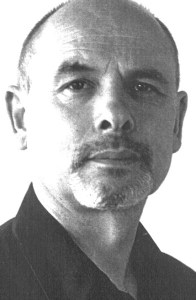
Anthony Howell is a poet and novelist whose first collection of poems, Inside the Castle was brought out in 1969. In 1986 his novel In the Company of Others was published by Marion Boyars. Another novel Oblivion has recently been published by Grey Suit editions. His Selected Poems came out from Anvil, and his Analysis of Performance Art is published by Routledge. His poems have appeared in The New Statesman, The Spectator and The Times Literary Supplement. His articles on visual art, dance, performance and poetry have appeared in many journals and magazines including Artscribe, Art Monthly, The London Magazine, and Harpers & Queen. In 1997 he was short-listed for a Paul Hamlyn Award for his poetry. His versions of the poems of Statius were well received and his versions of the poems of Fawzi Karim were the Poetry Book Society Recommended translation for 2013.


Single copies may be purchased on ebay – just click the word.
Comments:
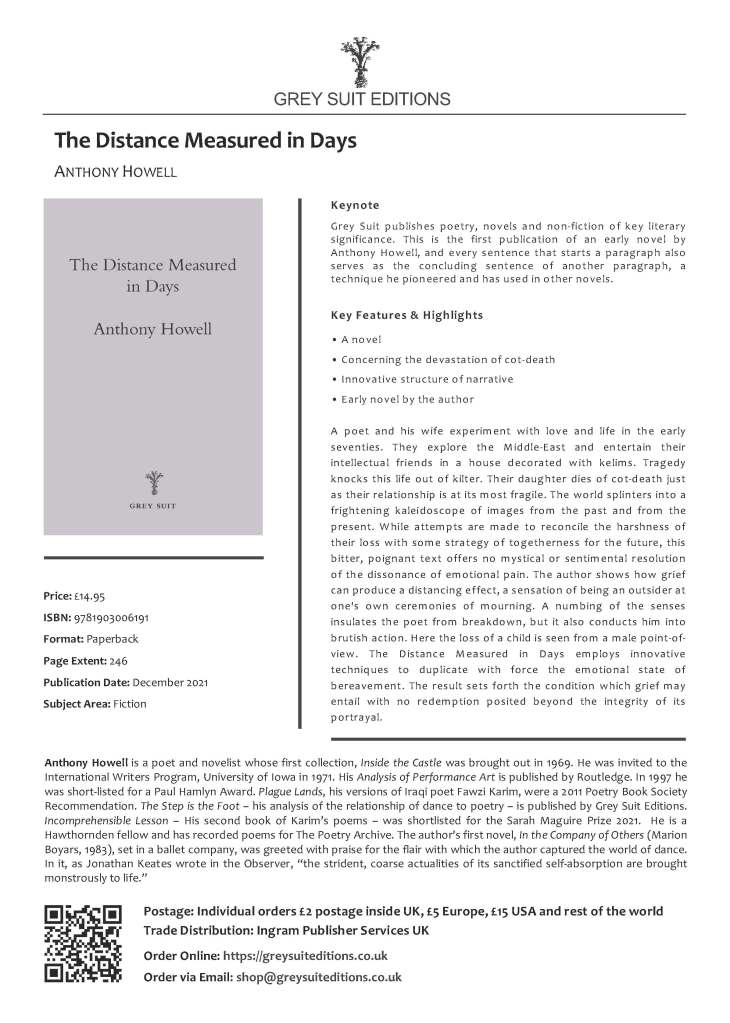
“I have finished the novel and found it challenging, emotionally, because it defies the reader’s expectations, as its main characters are frustrating .The raw contradictions of the man’s response to his daughter’s death are complex, shocking and convincing ,but his solutions made me want to shake him . The leveret memories, which had nothing immediate, difficult or ambivalent attached, were too heartrending to read I ended up avoiding them. The distinction between the artistic and important non-fuckable friends and others made me laugh. I think like that sometimes. I can’t help thinking that Inge was within reach so many times, not just on the desert trip, but in London, that the man had resolved to pay lip service to the relationship, but knew it was neither the answer nor a source of solace, and turned away.
Random thoughts, Anthony. But it is significant perhaps that Inge’s response to adventures was a sharp “grow up” and stop smoking weed .Neither statement means much when two people are looking for different paths/forms of salvation. I spent eight days, with a Libyan man who spoke no English riding through the Sahara, accompanied by a boy .No saddle, no tent, just holding on to the camels neck with my feet and digging a hole to sleep at night.I picked up tics .I don’t think the desert is ideal for reflection. Too many corpses being eaten by crows, physical stress, numbing landscape. The spirit is an indulgence when you are struggling with the exhaustion of the body.
A final thought, when you become aware that cot death is central to the story, the reader is programmed to prepare a dose of empathy and wait for the right moment to spill it. You don’t provide the opportunity for that kind of mawkish sentimentality because the tensions of the parents’ relationship takes centre stage . I enjoyed it, Anthony, thank you for the copy, which I will read again.” Sylvia Mejri
“We hire camels and a guide, and later in the day we ride out of the village. Our camels dip and lurch along on their flat, cloven pads. Slowly we approach a sign – ‘Timbuctoo, 40 jours’. We come abreast of it, and then we plod past it…”
Harry Harker and his Norwegian wife Inge have come to Morocco in what we might call a grief holiday: a doomed attempt to escape the pain and guilt resulting from the unexpected death of their infant daughter. And soon we discover that a distance measured in days may also refer to the distance between people, even when they are sharing a bed and entwined in each other’s arms.
Anthony Howell: poet, essayist, dancer, choreographer, uncompromising political commentator. And if this CV weren’t intimidating enough already, we should add novelist to the list.
In his latest book, his text shifts so effortlessly between timelines, tenses and first and third-person narrative that, at least until one becomes accustomed to it, a sensation akin to faint giddiness is engendered.
We journey with Harry into his distant past, where he adopts an abandoned leveret, more recently as we follow his sexual gymnastics, then into the present in the ‘desert Sud’, and his sojourn in the Philippines as a guest of the Marcos family. But not in that order. Or anything like it.
There is no happy ending here, no meaningful conclusion. Just intelligent people struggling to lead their lives in a world without convenient meanings or conclusions.” Steve Glascoe, author of Operation Violet Oak, Seren 2022
This is a list of earlier publications (all now available from GS Editions, 33 Holcombe Road, London N17 9AS UK):
Oblivion
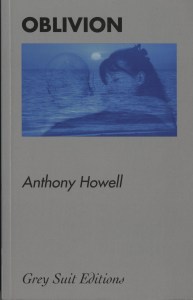
217 pages, published in 2006
ISBN 1 903 006 02 3
Sonnets

47 pages, published in 1999
ISBN 1 903 006 00 7
Heron of Hawthornden

unpaged, published in 2020
ISBN 978 1 903006 18 4
We also publish publications by
Click on each title for the link to more information!
Gertrude Mabel May – An ABC of Gertrude Stein’s Love Triangle – by Gwendolyn Leick.

Written by Mabel Haynes’s granddaughter following the fortuitous discovery of her grandmother’s connection to Stein, this is an innovative exploration of an intimate, complex relationship between three women.
While this book doesn’t follow a chronological form, its subject could be said to begin with Gertrude Stein’s first novel, Q.E.D., which was never published during her lifetime. Q.E.D. represents Stein’s attempt to deal with her first love affair with May Bookstaver, who was also the friend and lover of Mabel Haynes. All three were students at the same Boston medical school: “they came of age in the gilded age and were of a class that expected them to display themselves with the right cut of their garments, the right sort of bearing to carry it off.” While the impact and influence of these women on Stein’s writing has been examined, this is the first time the lives of the women themselves have been fully explored.
The Step is the Foot – Dance and its relationship to Poetry by Anthony Howell
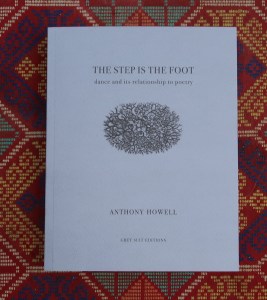
This fascinating study into the relationship between dance and poetry – the “step” of dance, and the “foot” of verse – presents a complex, intricate interlacing of disciplines. Dappled with personal anecdotes alongside probing evolutionary questions, historical depth and contemporary insights, it is at once thought-provoking and engaging.
The author’s experience as both a dancer and poet inform his unique investigation. He ascribes his long-held passion for both to a deep-rooted childhood awareness of rhythm: “Rhythm is common to both pursuits. Increasingly I have come to feel that dance is a language and that language is a dance.”
Collected Complete Poems – by Iliassa Sequin
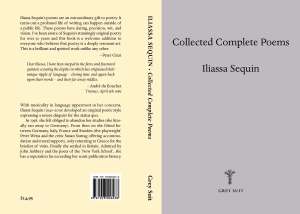
Iliassa Sequin was born in 1940 on a small island in the Cyclades, where her father was a high school teacher. Soon after the family moved to Athens.
With musicality in language uppermost in her concerns she developed an original poetic style and this led to her being befriended by Odysseas Elytis (later a Nobel prize winner). Family opposition to her career as a writer and an actress prompted her to move to Germany. From then on she flitted between Germany, Italy, France and Sweden becoming a friend of Peter Weiss and Susan Sontag, Giuseppe Ungaretti, André du Bouchet and Paul Celan. John Ashbery published her work in the Partisan Review, and a sequence of her quintets was published by Peter Gizzi in O-blek Editions. Later she moved to Britain, and married the artist Ken Sequin. Her work is notable for its musical beauty, its distinct structure and particular typographical decisions. She died in the winter of 2019.
The Cross of Carl – An Allegory – by Walter Owen

First published in 1931, The Cross of Carl is a book describing trench warfare with a visionary intensity. It is a masterpiece of the imagination, and one of the most terrifying books you will ever read. The Times Literary Supplement review, on 16 July 1931, called the book “A war allegory” that, “brings back the ugly side of war psychology; it is a description of one of the ‘corpse factories’ of legend – an unbearably ghastly description… This record of what the author himself describes as “an abnormal pathological process” induced by the psychic perturbations of the War, is put forward in the belief that the experience may foreshadow some sort of development in the collective consciousness of mankind.” It was foresight, in a way, but of something more horrible, which would be the Nazi holocaust of World War II.
The Chap-Books:

Just Visiting – Pamela Stewart lives on a farm in western Massachusetts with seven dogs and some other beings. Her most recent full-length book of poems is Ghost Farm (Pleasure Boat Studio, 2010). She expects, shortly, to arrange a small and delightful gathering of letters between the late poet Lee McCarthy and Guy Davenport. Published 2014 – ISBN 978-1-903006-06-1
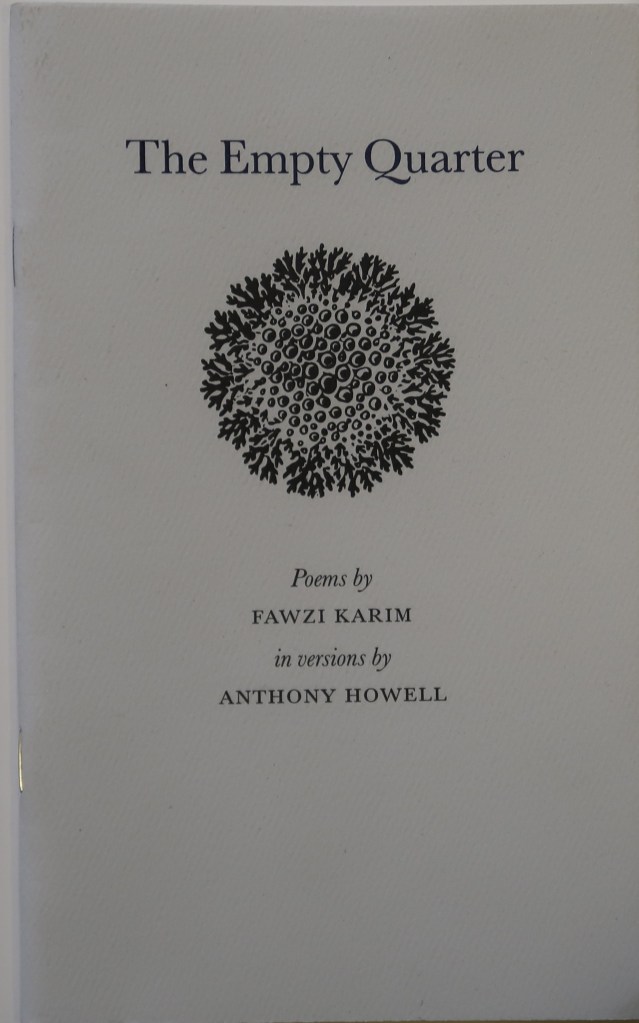
The Empty Quarter: poems by Fawzi Karim in versions by Anthony Howell after translations made by the Author. Born in Baghdad in 1945 and now living in London, Fawzi Karim is rapidly establishing a reputation as a major figure in contemporary poetry. Plague Lands, his first book of poems in translation was a Poetry Book Society recommendation for 2011. Anthony Howell’s first collection, Inside the Castle, was brought out in 1969. His most recent book of poems is The Ogre’s Wife, Anvil 2010. Published 2013 ISBN 978-1-903006-04-7

The Wreckage – Born in Montreal, Kerry-Lee Powell has lived in Antigua, Australia and the United Kingdom, where she studied Medieval and Renaissance Literature at Cardiff University. Her work has appeared in The Spectator, MAGMA and The Boston Review. A full collection of poetry will be published in Canada by Biblioasis Press in 2014. The lyric poems in this pamphlet were inspired by a shipwreck endured by Powell’s father during the Second World War, his subsequent struggle with post-traumatic stress disorder, and eventual suicide. Published 2013 ISBN 978 -1-903006-05-4
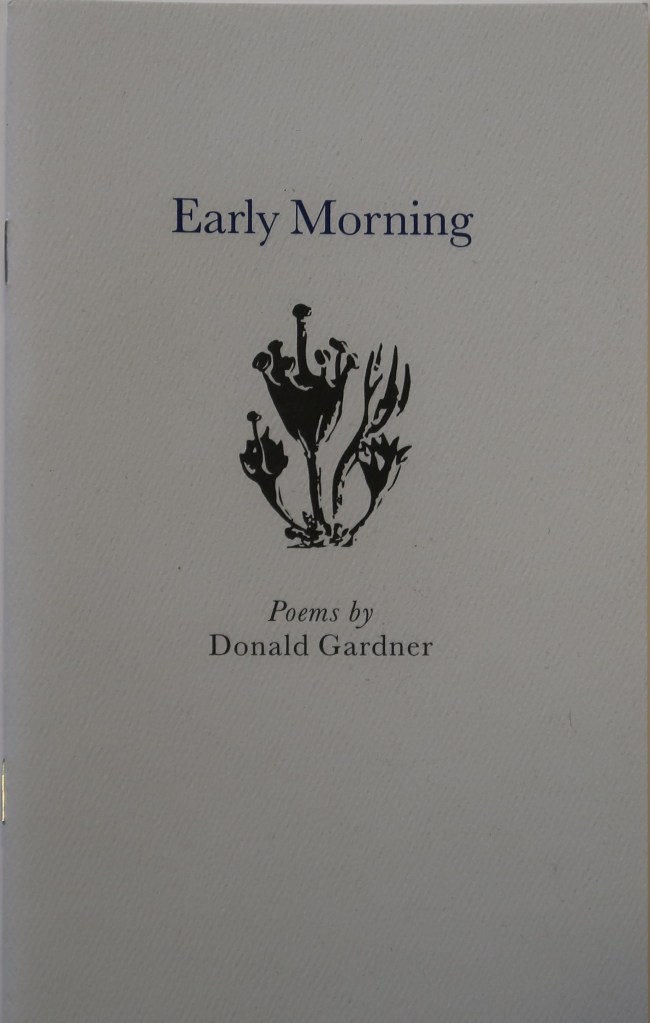
Early Morning – Donald Gardner has been writing poetry since the early 1960s. Recent collections include The Wolf Inside (2014) and The Glittering Sea (2006), both published by Hearing Eye. He is also a translator of poetry and his selection of Remco Campert’s poetry, In those Days (Shoestring 2014) was awarded the Vondel Prize for literary translation. Born in London, he divides his time between Amsterdam and Kildare. Many of these new poems started life in the early morning. First thing, before the mind steps in to remind you of more irksome issues, that’s when I usually write. ‘Early morning’ is not so much the theme of this book as the background music. Published 2017 ISBN 978-1-903006re10-8
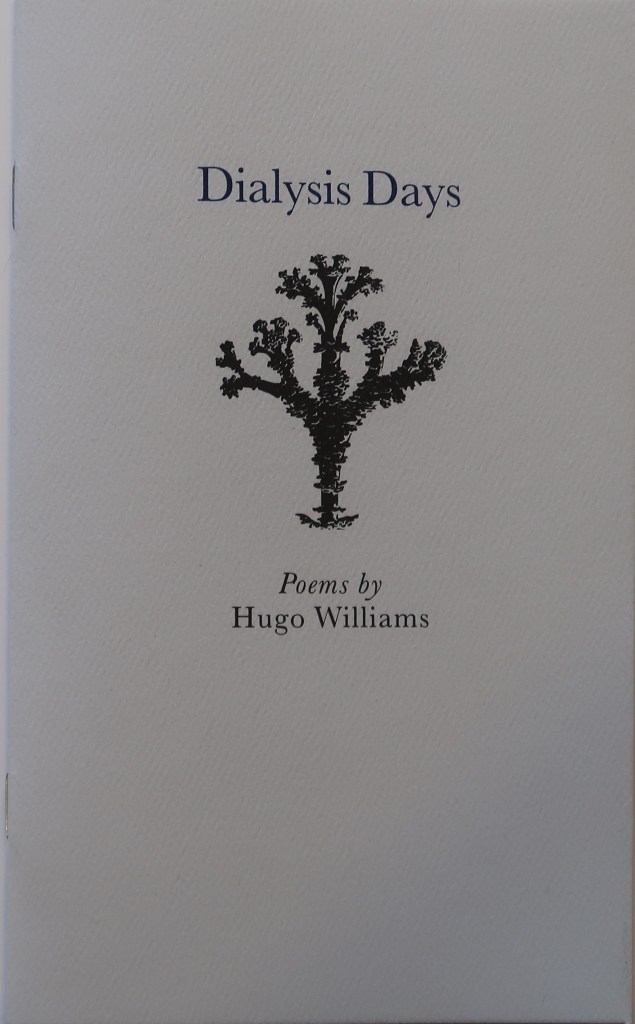

Paper-Money Lyrics – Alan Jenkins has published six volumes of poetry, the most recent of which are A Shorter Life (2005) and Revenants (2013). He edited the Collected Poems of Ian Hamilton (2009). White Nights, a volume of his translations from French, will appear in 2015. He has taught in Paris and the United States but has lived for most of his life in London, where he works as Deputy Editor and Poetry Editor of the Times Literary Supplement. Published 2014 ISBN 978-1-903006-07-8

Sonnets from Elizabeth’s – after Elizabeth Barrett Browning’s Sonnets from the Portuguese. Rosanne Wasserman’s poems can be found in print and online, in the Best American Poetry annual series, Ek-phra-sis, Conduit, Jacket 2, Maggy, How2 and elsewhere. Her books of poems include The Lacemakers (1992), No Archive on Earth (1995), and Other Selves (1999), as well as Place du Carousel (2001) and Psyche and Amor (2009), collaborations with her husband, the poet Eugene Richie, with whom she runs the Groundwater Press, a nonprofit poetry publisher. She has written on John Ashbery and Grace Paley for Massachusetts Review; on Pierre Martory James Schuyler and Ruth Stone for American Poetry Review; and on Marianne Moore, Dara Wier and others. She and Eugene Richie co-edited Ashbery’s Collected French Translations (2014). Published 2017 ISBN 978-1-903006-09-2

Anchorage – Lorraine Mariner was born in 1974 and lives in London where she works at the National Poetry Library, Southbank Centre. She has published two collections with Picador, Furniture (2009) and There Will Be No More Nonsense (2014) and has been shortlisted for the Forward Prize twice, for Best Single Poem and Best First Collection, and for the Seamus Heaney Centre Poetry Prize.
Review of Lorraine Mariner’s Anchorage – now in London Grip
* * *
Chap-books are £5 each post free in the UK from Books at The Room, 33 Holcombe Road, London N17 9AS. Special deal – Three chap-books for the price of two – £10 post free in the UK from the same address. Include address to mail to and which chap-books you want.
Visit Grey Suit Editions UK for details about all our published books, or scroll down on our blog (Journal) – where they can be found as well.
You can now view an extract of Gertrude, Mabel May on Love Reading

And an extract from The Step is the Foot, also on Love Reading.
 Grey Suit Editions UK